PUZRU does not publish a generated board just because it looks plausible. A candidate puzzle has to satisfy the same structural rules that players see, prove that only one completed grid works, and pass a logical no-guess quality gate before it can become part of the live puzzle pipeline.
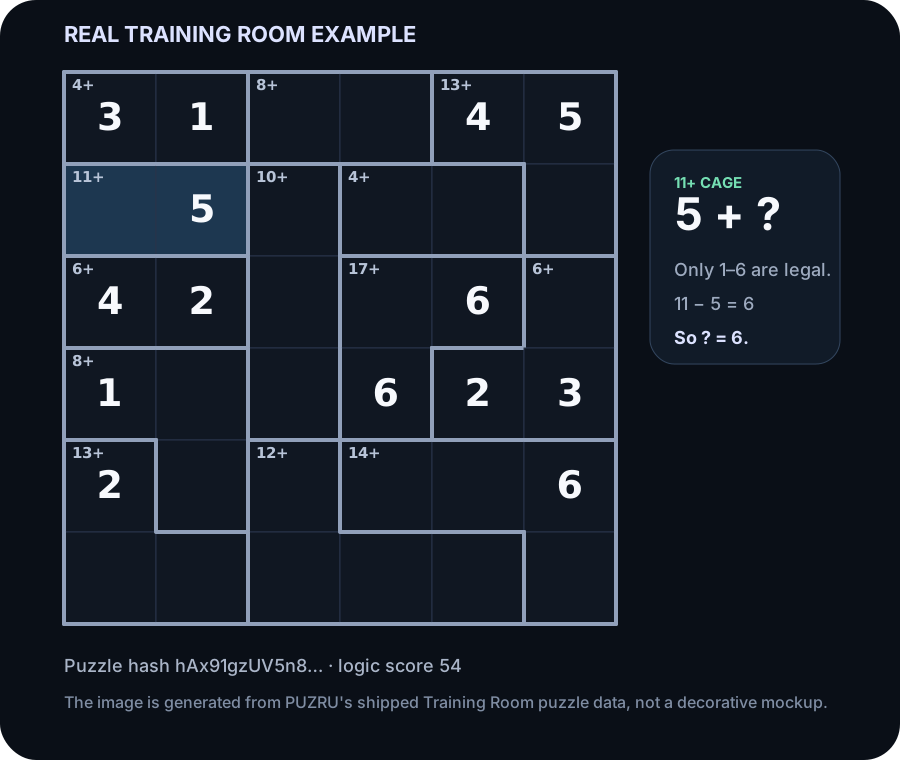
1. Start from a valid 6×6 solution
The underlying grid follows the Latin-square rule: every row and every column contains the digits 1 through 6 exactly once. That solved structure is the foundation for the cage puzzle shown to players.
2. Preserve the Chain contract
After a completed live round, exactly six positions are carried into the next solution — one position in each row and one in each column. The other thirty solution positions are required to change. Carrying values forward connects consecutive Worlds without allowing the next puzzle to skip its own quality checks.
3. Build cages around the hidden solution
Connected cells are grouped into cages and each cage receives the sum of its solution values. Those totals create the arithmetic constraints that interact with row and column uniqueness on the visible puzzle.
4. Prove there is one exact solution
A candidate is not accepted merely because the intended solution fits. PUZRU checks whether another complete grid can satisfy the same givens, row rules, column rules and cage sums. A production candidate must resolve to exactly one solution.
5. Check for a logical no-guess path
Uniqueness alone is not enough. PUZRU also runs a bounded logical solver and records a logic score and deduction trace. The candidate must be solvable through the accepted deduction model rather than depending on a lucky speculative branch.
6. Keep generation separate from public history
Generation proves a puzzle is eligible to exist. Public archive history is created only from completed live rounds. Archive pages can then expose the real board, quality profile, Discoverer result and Chain proof produced by that completed World.
What the public archive proves
An indexable archive detail page is gated again: it needs a completed round, a valid Chain hash, exact uniqueness, a no-guess result, a logic score, a deduction trace and puzzle/solution integrity. That keeps Search pages tied to real PUZRU history rather than manufacturing pages around keywords.
Put the idea into practice
The fastest way to understand the interaction between row, column and cage constraints is to solve a board. Start in the 200-puzzle progressive Training Room, then enter the live world whenever you are ready to race for Discoverer.